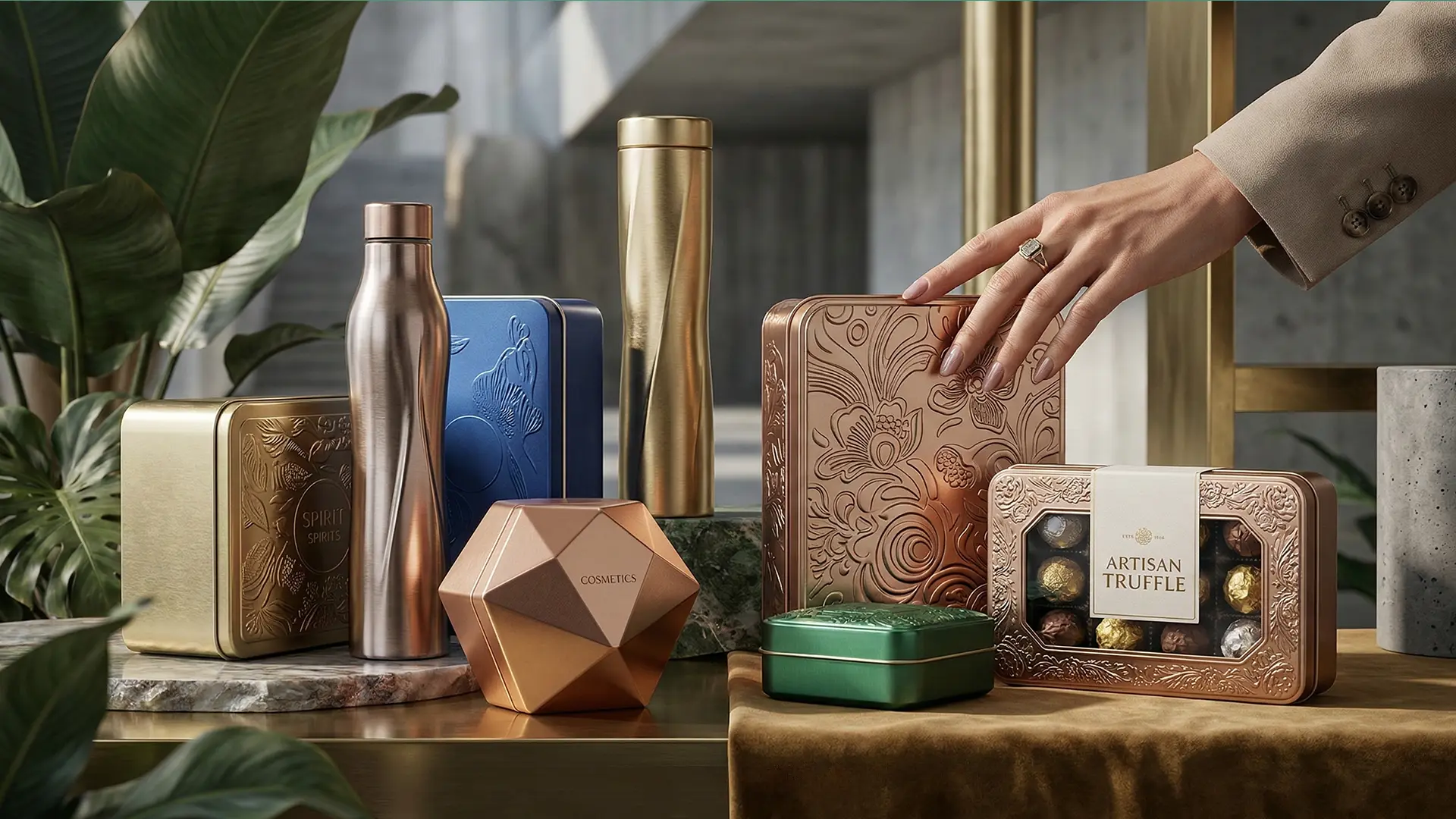
The Future of Circular Design: How Metal Packaging is Redefining Sustainable Luxury
In an era of conscious consumerism, packaging is no longer just a container. It has become a brand manifesto — a physical declaration of what a company believes, what it values, and what kind of future it is building. For premium brands operating in 2026, that declaration must simultaneously communicate uncompromising quality and authentic sustainability.
Metal packaging has emerged as the material that achieves both with greater conviction than any alternative. Here is why circular design and premium metal are converging to define the next decade of luxury packaging.
What Is Circular Design — and Why Does It Matter?
Circular design is a philosophy that treats packaging not as a disposable endpoint, but as a material resource in a continuous loop. Unlike the traditional linear model — make, use, discard — circular design asks a fundamental question at every stage of the design process: what happens to this packaging after its first use?
The answer must be built into the design itself. A circular approach considers:
- Material recovery: Can the packaging be recycled without losing material quality?
- Disassembly: Can the components be separated easily for processing?
- Reuse: Can the packaging serve a meaningful second purpose?
- Reduction: Has the material been used as efficiently as possible without compromising the premium experience?
For luxury brands, circular design presents both a challenge and an opportunity. The challenge is maintaining the sensory richness and visual sophistication that premium consumers expect. The opportunity is that metal — properly designed — meets both criteria better than any other packaging material available today.
Why Metal Is the Circular Economy’s Premium Material
Metal’s credentials in the circular economy are extraordinary. Approximately 75% of all aluminium ever produced is still in use today — a statistic that no other packaging material can approach. Steel is the world’s most recycled material by volume. Both can be recycled indefinitely without any degradation in quality.
This is not a marketing claim. It is a fundamental property of the material itself. When a brand chooses a premium metal tin, they are choosing a material that can cycle through the economy permanently, never ending up in landfill as long as it enters the recycling stream.
But the most powerful circular argument for premium metal packaging is not recycling — it is that premium metal packaging is almost never discarded in the first place.
A beautifully engineered tin finds a second life naturally and effortlessly. It migrates from the gift table to the bedroom shelf, holding jewellery and keepsakes. From the shelf to the kitchen, organising loose-leaf teas and spices. From the kitchen to the home office, housing stationery and small tools. A premium tin that remains in active use for five years has effectively removed itself from the waste stream entirely — while continuing to represent the brand that created it.
This is circular design at its most elegant: packaging that people choose to keep.
PPWR and the Regulatory Imperative
Circular design is no longer purely an ethical choice for brands operating in Europe. The EU’s Packaging and Packaging Waste Regulation (PPWR) is transforming sustainability from a brand value into a legal requirement.
The PPWR introduces mandatory recycled content targets, recyclability requirements, and restrictions on unnecessary packaging elements. For brands selling into EU markets, compliance is not optional — and the timeline is tightening.
The key principles that PPWR demands align directly with best practice in metal packaging design:
Monomateriality. Packaging constructed from a single material — or from materials that can be easily separated — achieves the highest recycling rates. A pure aluminium tin with no plastic inserts or laminated linings is a model of PPWR-compliant design.
Lightweighting. Advanced aluminium and steel alloys allow packaging engineers to reduce material weight without sacrificing structural integrity or tactile quality. Less material means lower carbon footprint in production and transport, while maintaining the premium feel that luxury consumers expect.
Sustainable surface treatments. Water-based inks, UV-curable coatings, and solvent-free finishes preserve the premium visual quality of metal packaging while ensuring that surface treatments do not contaminate the recycling stream.
For forward-thinking brands, PPWR compliance is not a constraint — it is an opportunity to redesign packaging that is simultaneously more sustainable, more beautiful, and more legally robust.
Design for Recycling: Practical Principles
At NASS Studio, we apply Design for Recycling (D4R) principles at the earliest stages of every project. This means asking recyclability questions before the first sketch is drawn, not as an afterthought during production.
The most important D4R principles in premium metal packaging design are:
Avoid inseparable multi-material assemblies. A metal tin with a glued-in plastic tray creates a composite that is difficult and expensive to recycle. Designing the same tray in metal, or as a removable insert, eliminates the problem entirely.
Design closures for easy separation. Magnetic closures, friction-fit lids, and snap-ring closures can all be designed for easy consumer separation and material-specific recycling.
Choose coatings and inks for compatibility. Not all surface treatments are equal from a recycling perspective. Working with suppliers who use recyclable-compatible finishes ensures the packaging performs both aesthetically and environmentally.
Optimise gauge for function. Over-engineered metal thickness adds cost, weight, and carbon without improving the consumer experience. Precision engineering to the minimum effective gauge is both economically and environmentally superior.
These principles do not require compromise on quality. They require precision in design — which is exactly what premium packaging demands anyway.
Metal Packaging Trends Driving Circular Design in 2026
The most exciting developments in premium metal packaging are converging sustainability and aesthetics in ways that would have seemed impossible a decade ago.
Structural minimalism. The move away from heavy decoration toward precision-crafted simplicity reduces surface treatment requirements and improves recyclability, while simultaneously representing the most sophisticated design direction in the luxury market.
Smart integration. Embossed QR codes and NFC tags integrated directly into metal surfaces — without adhesive labels or plastic components — connect physical packaging to digital experiences while maintaining monomaterial integrity.
The heritage revival. Classic apothecary, tobacco, and confectionery tin forms are being reimagined for modern organic cosmetics, artisan spirits, and gourmet food. These heritage forms have strong circular credentials: they were originally designed for reuse in an era before disposability was an option.
Collector’s edition design. Limited edition tins designed explicitly as collectible objects represent the ultimate expression of circular intent — packaging engineered to be kept indefinitely, eliminating disposal entirely.
AI-assisted manufacturing. Advanced manufacturing technologies are enabling surface textures, structural forms, and embossed details that were technically impossible or prohibitively expensive five years ago. The result is premium metal packaging that achieves greater aesthetic sophistication with less material.
The Business Case for Circular Metal Packaging
Beyond regulatory compliance and environmental responsibility, circular design in premium metal packaging makes straightforward commercial sense.
Brand longevity. A tin that lives on a customer’s shelf for three years delivers daily brand impressions at zero ongoing cost. No advertising medium comes close to this combination of intimacy, frequency, and permanence.
Premium pricing justification. Consumers who understand the quality and sustainability credentials of premium metal packaging are willing to pay a meaningful price premium. The packaging becomes part of the product value proposition, not just its container.
Regulatory resilience. Brands that invest in circular design now are building regulatory resilience for the decade ahead. As PPWR requirements tighten and new markets introduce similar frameworks, packaging designed on circular principles will require minimal adaptation.
Consumer alignment. Research consistently shows that premium consumers — the audience for luxury metal packaging — are among the most engaged with sustainability values. Packaging that embodies those values genuinely, rather than superficially, builds lasting brand loyalty.
NASS Studio’s Approach to Circular Design
At NASS Studio, circular design is not a separate service or an add-on consideration. It is integrated into our design process from the first conversation with every client.
We begin every project by mapping the full lifecycle of the packaging: production, transport, retail, consumer experience, and end-of-life. We identify the points of greatest environmental impact and the greatest design opportunity — because in circular design, these are often the same point.
We then apply our expertise in metal engineering, surface treatment, structural design, and regulatory compliance to create packaging that achieves your brand’s commercial and aesthetic objectives while building genuine circular credentials.
The future of packaging is circular. The future of luxury packaging is circular metal. We are ready to help you design for that future.
Ready to Design for the Circular Economy?
If you are ready to explore how circular design principles can elevate your packaging — both aesthetically and environmentally — we would love to start a conversation.
Get in touch with NASS Studio — we work with premium brands worldwide who care as much about the planet as they do about their product.
NASS Studio is a premium packaging design studio based in Zielona Góra, Poland. We specialise in luxury structural packaging for spirits, cosmetics, perfumery, jewellery, and gourmet food brands worldwide.